REEF LIFE CREATIONS · THE MANUAL
The Manual
Punch Bowl Techniques
Once I figured it out, I knew I needed just one more thing before giving it away: Mr. Limpet. Raising him to Day 45 was the proof I needed to encourage and inspire others. I have not changed the system since I first built it. I'm leaving it in its raw form so others can make it their own.
As I wrote to Todd Gardner in January 2025: "This bowl system is small, simple and it works. I hope this idea or something like this would make a great introduction to get hobbyists on board the captive-bred fish train."
Why captive-bred
The hobby suffers from a lack of captive-bred species, and for as long as that is true the full enjoyment of a marine tank may never be reached. Most captive-bred fish get along in a group or a community and enjoy being fed. That is a different start from the stress and disease that come with a new environment for wild marine life. Reef Life Creations is not here to oppose the aquarium and aquaculture industry. It is here to help it grow with more captive-bred species.
The System
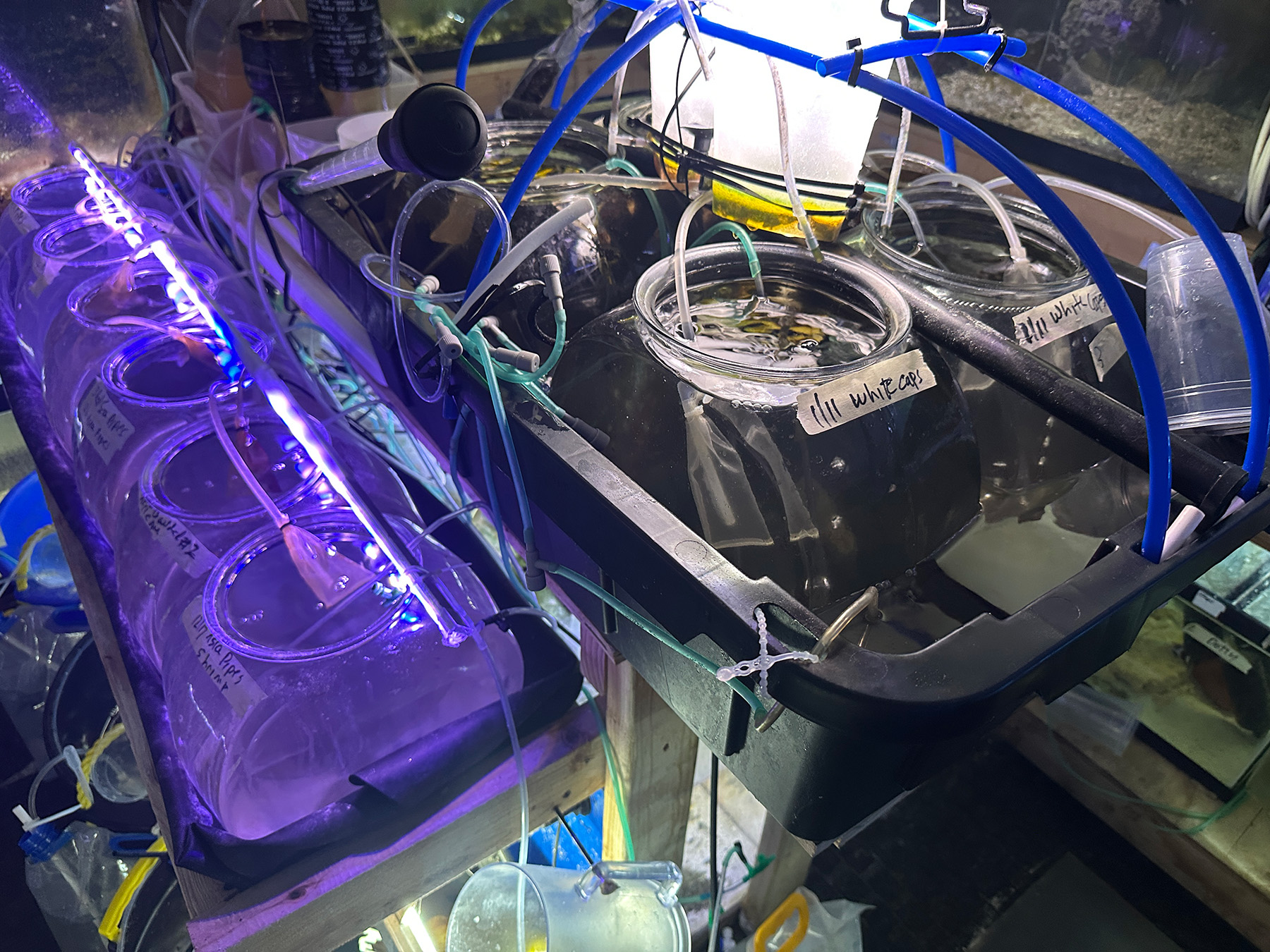
A standard 2-gallon glass punch bowl — the same wide-rimmed hemisphere shape that's sat on kitchen counters for generations — has a curve that, paired with a single low-velocity air line, creates a gentle, continuous circular current close to a miniature Kreisel. Unlike the rigid walls and mechanical pump impellers found in most commercial rearing tanks, that curved glass interior keeps a laminar loop moving without subjecting fragile pelagic larvae to shear stress.
The full setup runs four of these bowls in sync off a shared, gravity-fed level-regulation system I call the 120-Micron Siphon Matrix: a length of fine nylon mesh doing the job a mechanical skimmer would otherwise need motors and moving parts for. As water rises to the overflow line, that mesh sock quietly skims surface film, purges fine debris, and vents oversized live food out of the loop — no touching, no manual siphoning, no risk of pulling a larva out with the waste stream.
The second piece of the mechanics is where the filter screens sit. Placed inline with the current rather than across it, they create a calculated low-velocity pocket just behind the mesh — the Hydrodynamic Rest Oasis — where larvae too weak to fight the main loop can drift, recover, and feed without being swept into the screen itself. It's a small placement detail, but it's the difference between a bowl that quietly kills its weakest larvae and one that lets them catch up.
The same bowl does double duty. It rears delicate larvae, and when a run fails, the fallow bowl left sitting often quietly fills with copepods on its own — turning a loss into the next attempt's food supply. That's exactly how Mr. Limpet was found: a punch bowl labeled "White Cap 800" that had crashed days earlier had built up a dense copepod bloom by the time a handful of newborn fry landed in it.
Blind Aquacultur
The bowls run under infrared camera monitoring rather than constant visual checks under regular light — enough to observe survival, growth, and live-food type and quantity without disturbing anything inside. That's most of what "Blind Aquaculture" describes on a technical level: watching without looking, in light the larvae never notice.
But the term came from somewhere more honest than a camera setup. During a long stretch running at roughly half of my normal available capacity, I started half-joking to The Biota Group's Florida Facility Manager, who
receives and ships livestock like mine worldwide, that I was trying to be the worst aquaculturist in the world. When he asked about fish availability, I realized the joke was true in a specific way: I wasn't actually looking into the running bowls with larval fish day to day. I was adding live food and a little microalgae on instinct, on a schedule, without checking. Blind, in the literal sense.
That's the real point behind the phrase. Even when someone gets too relaxed with larval rearing in a punch bowl — even when the checking stops — success still happens. Sometimes it's a single survivor pulling through against long odds, the way Mr. Limpet did. Sometimes it's a result with a shot at real recognition in the field, the way the Orange Spotted Goby's possible species-first status might turn out to be. Both are as much a testament to Blind Aquaculture as to anything I did on purpose.
The Live-Food Engine
Larvae don't survive on good intentions; they survive on a steady, dense supply of the right food at the right time, delivered on a schedule the animals can set their biology to.
- Microalgae — Isochrysis galbana (T-Iso), Chaetoceros gracilis, and Rhodomonas salina, run on a strict 12-hour on/12-hour off photoperiod rather than continuous light, cultured without lab glassware and tracked by eye through visual density rather than instruments.
- Copepods — Apocyclops panamensis and Parvocalanus crassirostris, cultured at high density in simple containers and delivered straight into the bowls to match hatch timing.
- Biosecurity — hydrogen-peroxide wipe-downs between runs, and a twice-daily ClorAm-X dosing routine that's been running continuously for more than three years without a break in the schedule.
- The bowls themselves, used for more than one purpose — the same setup that rears fish larvae can just as easily raise Lysmata shrimp or urchin recruits between fish runs.
None of it requires a laboratory budget. It requires patience, close daily observation, and a willingness to let a "failed" bowl become useful again.
Broodstock: Obtaining It and Choosing Where to Start
Wild-caught stock is a poor starting point. In my experience, wild-caught pipefish rarely survive beyond a few weeks after import. I bought replacement brood stock and tried many times to keep the cheapest and most commonly imported pipefish on dealer lists, the red banded pipefish (Dunckerocampus dactyliophorus). I never kept a pair alive long enough to breed them.
Start with captive-bred stock when you can. Aquacultured pipefish are much easier to feed than wild ones, which removes the main problem in keeping them. The captive-bred pipefish from my bowls are already trained onto frozen baby brine shrimp, chopped mysis and PE Calanus.
Choose species that breed fast. Pipefish are the example I give. They breed quickly and give good, steady hatches all year round. That makes them a bread-and-butter species to start with: a dependable staple that lets you learn the routine of rearing before you take on something rare. I raised the Yellow Banded Pipefish from birth to sale in 2-gallon bowls, and the Bluestripe and Janss' Pipefish began the same way.
Keep a spare. A fish you cannot replace from the wild is the reason for the rule in the next section, Two Pairs and a Spare.
Broodstock Management & The Larval Collection
Getting larvae into the bowl safely matters as much as anything that happens once they're there. Collection is done with a turkey baster, timed to within minutes of a hatch event rather than left for a routine check later in the day.
The clearest lesson from years of this protocol: when a batch crashes in the first hour after hatching, the cause almost never traces back to the collection itself. It traces back to the broodstock's own nutrition — specifically vitamin and essential fatty acid gaps in what the parents were fed before spawning — not to handling stress on the larvae. That reframes broodstock diet as the actual first step of larval rearing, well before a single larva hits the water.
Because a breeding pipeline for a rare species can collapse the moment one half of a pair is lost, the operating rule is simple: Two Pairs and a Spare. Keep a backup breeding pair in reserve for anything difficult to source again, rather than running a single, irreplaceable pair with no fallback.
Why It Matters
Every species someone successfully breeds at home supports the health of wild reefs. My work with the Whitecap Goby, also called the Dancer Shrimp Goby — named directly in CORAL Magazine's 2023 species-first writeup and now sold through The Biota Group — started with exactly this kind of low-overhead setup. That same 2023 list put the running total at 468 marine aquarium fishes ever successfully bred in captivity at least once — against roughly 2,250 species in the trade overall. That gap is enormous, and it's exactly the gap this open-source approach is built to close.
Recognized by the Field
Small-vessel rearing isn't a technique I invented in isolation — it's one that people with real editorial standing in this hobby have independently arrived at too, once they saw it. When I shared my results breeding the Orange Spotted Goby (Amblyeleotris guttata) — raised in the very same 2-gallon bowl as a settled batch of Whitecap Goby larvae, in polyculture — Matt Pedersen, a longtime editor at CORAL and AMAZONAS Magazines, told me the method simply "makes total sense," and pointed to his own history to explain why: his first Harlequin Filefish were reared in a 1-2 gallon fishbowl in a waterbath, a colleague at the Columbus Zoo & Aquarium once raised angelfish larvae in a pickle jar, and he'd personally had coral spawn in a 1-gallon apothecary vase in his own home. He also raised, on his own initiative, the possibility that the Orange Spotted Goby result could stand as a species first for the trade.
That's not a compliment I asked for — it's an assessment from someone whose job is evaluating exactly these kinds of claims, arrived at by comparing it to his own career's worth of precedent. Small glass vessels have quietly produced real breeding milestones for fifty years. A punch bowl is just the latest one.
As I've put it before: the data is whole, the proof is in the punch bowl, and the window is yours to command.
The Proof
The Window Is Still Open
A world-recognized species-first is one of the rarest prizes in this hobby — rarer, honestly, than most careers in the sciences ever produce. Mine found me sitting on a kitchen counter: an ordinary glass punch bowl, doing a job no laboratory setup was doing. It's still sitting there tonight, on shelves in houses everywhere, waiting for someone else to notice exactly what it's capable of. Two pairs and a spare, broodstock that are calm and well-fed, patience, and the discipline to stop checking so much — that's the entire cost of entry. The bowl is common. Nobody's cornered this. What's waiting on the other end of it isn't.
Knowing the method holds up under that kind of scrutiny is one thing. Knowing who's actually behind it is another — that's next.