REEF LIFE CREATIONS · THE PEOPLE BEHIND THE BOWLS
About Us
I didn't start out breeding reef fish. When I started college I planned to be a mechanical engineer. Then I moved to wildlife management, and then to aquaculture. I started community college in my late twenties while working full time, so I only took what I'd actually put to use. I never went through all the coursework it takes to earn three degrees, but over the years I have done the work of all three: building water systems as a licensed contractor, doing habitat restoration work at the Elkhorn Slough National Estuarine Research Reserve, and breeding marine fish and invertebrates.
Locksmithing prepared me for unlocking more than doors. It gave me the skills, and the mindset that failure is not an option. Visualizing tumblers, wafers and the turns of a dial, it becomes less of a craft and more of an art.
I found myself drawn to marine life and the challenges of saltwater aquariums, and that led me to aquaculture. As the profession moved from two-year to four-year degrees and beyond, I kept learning on my own terms. Each new profession was another door to unlock, and I rarely needed a degree to open it. My record below shows how I unlocked those doors and achieved what I set out to do.
The shrimp came first, during my college days. I raised peppermint shrimp through full molts across successive generations, and reared Scarlet Cleaner and Flame Shrimp using raw, untreated Tomales Bay seawater rather than anything mixed in a lab.
In the early 1980s I went from locksmith to state printer, and from that pay grade I was able to move laterally into a position with the California state fish hatcheries — salmon and steelhead hatchery work, learning the fundamentals of controlled spawning, egg incubation, and larval survival on species where the margin for error was measured in a season, not a species.
From the hatcheries I went to the Elkhorn Slough National Estuarine Research Reserve. I raised the shrimp again there, just as the Breeder's Registry was getting started, and that is how I was able to claim them. On the commercial side I was wholesaling Clownfish, Gramistes Blennies, and Engineer Gobies to a buyer in Martinez, California.
The turning point was a submission to the Breeder's Registry — the open, hobbyist-run precursor to a lot of what I'm doing now — reporting four different Lysmata shrimp species bred in captivity. It was met with real skepticism at first; nobody expected that many species from one setup. It took photo verification to be taken seriously. When they asked for photos, I was able to send them. Nearly everything went by mail in those days, and every photo had to be developed first. That episode is what put me in contact with Bill Addison, founder of C-Quest in Puerto Rico, and through him, Todd Gardner — two people whose own work shaped how I think about small-scale marine breeding to this day.
Government and Environmental Work
At Elkhorn Slough I coordinated volunteer teams that planted 35,000 native acorns to restore native oak forest where an invasive eucalyptus forest had been removed, and I served on the California Exotic Pest Plant Council. A graduate student studied the project, and it became the opening restoration exhibit of a show that opened in the San Francisco Bay Area and then traveled around the nation. This was in the early days of restoration work, when it was just starting to gain interest from land managers and conservation organizations. Elkhorn Slough is one of NOAA's National Estuarine Research Reserves, whose mission is "to practice and promote coastal and estuarine stewardship through innovative research and education, using a system of protected areas."
From Elkhorn Slough I was promoted within the California Department of Fish and Game (now Fish and Wildlife) to its new Marine Wildlife Veterinary Care and Research Center in Santa Cruz, the first facility in the United States built for the rescue, care and research of oiled marine wildlife, with an emphasis on sea otters. I commissioned it, bringing the labs, the veterinary hospital, the necropsy room and the physical plant, with its seawater pools and marine mammal enclosures, to a state of readiness. The center was tested before it was finished. In late October 1997, hundreds of seabirds coated in a vegetable oil began washing ashore along Monterey Bay. The building did not yet have working water pressure or heat, and oiled birds need both. I took charge of the physical plant, worked out an interagency agreement with the UC Santa Cruz maintenance division, and set up a computerized maintenance management system to keep the center ready for the next spill. More than 400 birds were cared for in a center designed to handle about 100.
Oasis Construction, Inc.
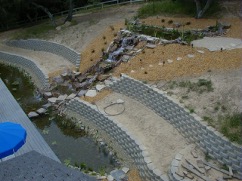
The upper and lower ponds with waterfall: the first water feature I ever designed and built, and the level I started from.
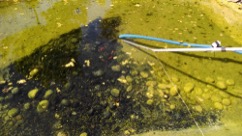
One of my non-stop pond vacuums at work: the clear path through the algae shows where it has already cleaned, with the fish left in place.
Why I Do This
The Breeder's Registry model stuck with me: open-source your results, let anyone with a tank and enough patience replicate them, and the combined effect supports the health of wild reefs. Every species someone else can successfully breed at home because I published exactly how I did it is one more way to support the health of wild reefs. That's the whole mission behind Reef Life Creations — not a single breakthrough, but a trail of markers anyone can follow.
I do not plan on letting my knowledge detour you. Everything in the Manual is written to be used, not admired from a distance.
I spent a lifetime finding the keys. Now I'm handing them to you.
Registered breeder ID: SOWDAV